

AI companions for everyone?


Doesn’t everyone deserve an AI companion of their own?
It’s always available. It won’t reject or judge you. It will always be on your side. It won’t fight or insult you. It doesn’t have its own problems to deal with, so it can focus on the person who matters most: you.
It will always “listen.” It will prioritize your feelings. It is, in many ways, the perfect companion.
Or is it?
AI companions tend to trigger an immediate reaction in most of us. For many, they’re dystopian. But for the millions of people who use them, they’re somehow comforting to turn to day after day. And the industry is already worth billions of dollars.
Recently, I sat down with Olga Titova, AI product manager at Wargaming with a background in cognitive science who had spent several years working on AI companion apps, Replika (10M+ users) and Blush. Her perspective is particularly valuable because she has seen both the technology and the people who use it up close.
We talked about why people turn to AI for connection, the appeal of frictionless relationships, the psychological risks of highly agreeable chatbots, and the uncomfortable reality that we are still trying to understand the effects of technologies that are already reshaping how people relate to themselves and each other.
What stood out in our conversation was how quickly these systems have moved from novelty to something that can evoke genuine attachment, grief, dependency, and even personal growth.
Ultimately, AI companions are merely simulations. While they may help some people practice difficult conversations or explore feelings, they may also hinder emotional development when they become substitutes for real relationships.

It’s possible that there's room to use AI to explore feelings or rehearse difficult conversations, but then these skills need to move into the real world.
The danger is when individuals don't merely use it as a tool for growth but rather as a permanent substitute for the real thing. As a way of avoiding it while still having some needs met.
Real connection can be difficult. Relationships are often painful as they are rewarding. Most LLMs tend to minimize cognitive friction. AI companions are designed to minimize the emotional variety too.
But even those of us not willing to use an AI companion outright, we often converse with LLMs to research, ask questions, brainstorm, draft emails—and even vent/ask for advice. It’s easier, for example, to ask a Chatbot an embarrassing medical question, than a person. Those who can’t access mental health support often turn to AI as well. Even if it’s three in the morning.
Here’s the thing that’s probably most important to understand:
The machine may not feel anything.
The person does.
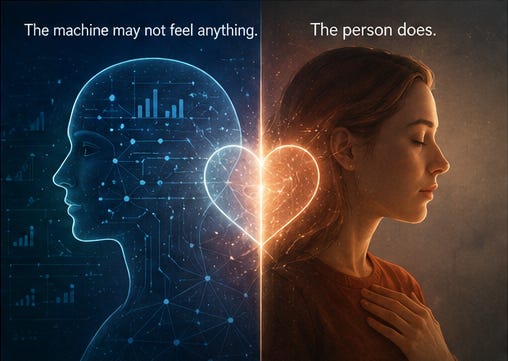
And once we recognize that, the conversation becomes much harder. It is no longer about whether these relationships are "real." It is about what happens when technology becomes capable of evoking real feelings in us. And what about the responsibilities of those who are building machines that appear human enough to trigger real emotions?
Whether AI companions ultimately become training wheels for human connection or substitutes for it remains an open question—although I tend to lean towards the latter camp, my guest is a little more optimistic.
But as with so many developments in AI, we are running a global social experiment in real time. The technology is advancing faster than our understanding of it. Researchers are still trying to measure its effects. Regulators are still trying to define appropriate guardrails. Meanwhile, millions of people are already incorporating these systems into their daily lives.
The conversation around AI companionship often oscillates between panic and enthusiasm. But curiosity might help ground it: Why are people seeking connection from machines? What needs are these systems fulfilling? What risks are they creating? And how do we preserve the benefits while minimizing the harms?
I suspect we'll be wrestling with these questions for some time to come.

Want to listen only? Find us on Spotify and Apple Podcasts.
Want to support my work? Here’s how you can help:
Consider becoming a subscriber (and enjoy a week of premium for free!)
Share my posts and Substack with people who might enjoy it. Liking and commenting also helps more people discover my essays!
Make a one-off donation via Buy Me a Coffee
Pick up a copy of my book, No Apologies: How to Find and Free your Voice in the Age of Outrage
It’s not really the subject of your article, but one thing that is interesting to consider here is the use of AI as an accessibility aid. For example, for people with ADHD an AI can really smooth out cognitive bumps. Store thoughts for later, review calendars for upcoming commitments, or better yet review emails for uncalendared commitments.
AI can also help with seeking employment accommodation, comparing workplace policies with practice and make it easier for those in need of accommodation to seek it.
They have no feelings. They can tell you the temperature, they can even tell you 20° F is cold and it’s also -6° C. But they don’t experientially know what “cold” feels like.
They can tell you how to do things, including how to commit mass murder and suicide. But they can’t tell you the pain your mass murder will trigger it the pain your suicide will evoke in those you leave behind.