
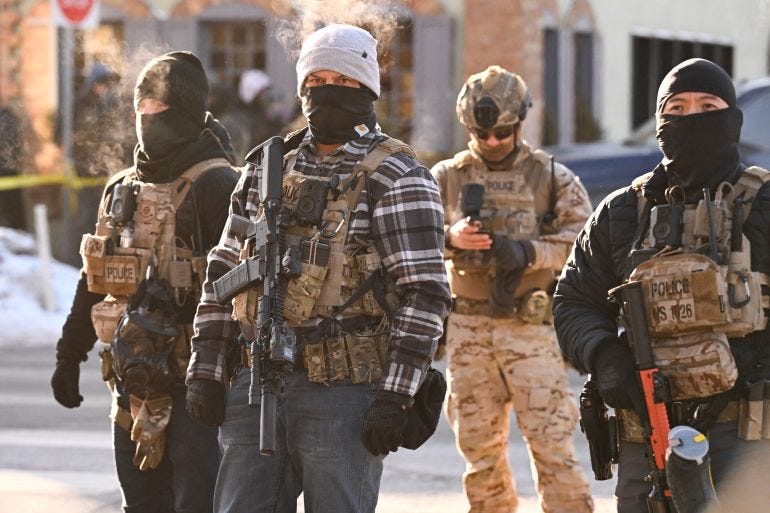
ICE: Two Deaths, Many Narratives
There are now two fatal shootings involving federal immigration enforcement officers in Minneapolis—the killings of Renee Good and Alex Pretti. Both of these have been captured on video and widely shared, inviting much public scrutiny and debate. Many of us might have watched the same videos, read the same analyses, and sifted through legal context, yet countless people have arrived at radically different interpretations of those same materials. Some it comes down to worldview, perspective, and politics. Some of it is due to absence of clarity on all the facts. And some of it might simply be contrarianism. There are many reasons.
Even recently, at a dinner with individuals whose political views largely align with my own, we found ourselves in disagreement on key aspects of these events.
In the end, the only point of consensus all of us seem to share is disturbingly simple: two people are dead. (Also, that whistles—having been watching these videos—are very irritating).
Regardless of whether one attributes responsibility to the ICE officers who fired the shots, or to Renee Good and Alex Pretti themselves for how they engaged with law enforcement, both incidents ended in loss of life. But I hope there is at least one point we can agree on: the troubling framing of these deaths and the speed with which it was done.
In the aftermath of the killing of Renée Good on January 7, 2026, Secretary of the U.S. Department of Homeland Security Kristi Noem immediately declared that it was an act of self-defense and essentially labelled Good a “domestic terrorist” who was intentionally using her vehicle to run over ICE cars. No doubt, supporters of ICE will agree with this characterization and believe that Good was indeed trying to run over an officer. Many others, watching the same footage, believe that she was trying to drive away and the officer would have avoided danger by getting out of the way, rather than shooting (especially considering that the vehicle kept moving even after the driver was deceased).
Given that the officer had a prior incident where he was dragged by a vehicle during a traffic stop last year, it is also possible to understand that from his perspective, he could have sincerely believed that Good was trying to run him over. But this is where certain legal procedures also come in. I won’t litigate all of this here, however, one can see that at the very least the situation is complex enough that it would be prudent for for government officials to pause before making such hyperbolic and rigid statements.
All Noem had to say was within the lines of, “This is a tragic situation for all involved and we will conduct a thorough investigation to determine why this has happened and how this may be avoided in the future.”
The next day Vice President J.D. Vance labelled Good’s actions as “classic terrorism.”
Furthermore, the Justice Department declined to open a civil rights investigation into whether the ICE officer’s use of deadly force was justified, instead launching one to look at ties between Good, her wife, and groups that have been protesting ICE— leading to the resignation of at least four senior leaders in the civil rights division, as well as six federal prosecutors in Minnesota.
Similarly, following the January 24, 2026 shooting of Alex Pretti—an intensive care unit nurse—people like Stephen Miller referred to Pretti as a “would-be assassin.”
Meanwhile, DHS posted the following:
“At 9:05 AM CT, as DHS law enforcement officers were conducting a targeted operation in Minneapolis against an illegal alien wanted for violent assault, an individual approached US Border Patrol officers with a 9 mm semi-automatic handgun, seen here.
The officers attempted to disarm the suspect but the armed suspect violently resisted. More details on the armed struggle are forthcoming.
Fearing for his life and the lives and safety of fellow officers, an agent fired defensive shots. Medics on scene immediately delivered medical aid to the subject but was pronounced dead at the scene.
The suspect also had 2 magazines and no ID—this looks like a situation where an individual wanted to do maximum damage and massacre law enforcement.
About 200 rioters arrived at the scene and began to obstruct and assault law enforcement on the scene, crowd control measures were deployed for the safety of the public and law enforcement.
This situation is evolving, and more information is forthcoming.”
Pretti was also labelled a domestic terrorist. However, bystander videos and other reports contradicted that narrative. Pretti carried a concealed weapon, which according to Minneapolis Police Chief Brian O’Hara was lawful (Pretti also had no criminal record). Based on video evidence, he didn’t draw the weapon. Further, it appears that Pretti was already disarmed before he was shot, with video showing a federal agent removing Prett’s firearm from his waistband during their struggle, though there is a possibility that the officer who shot him might have been unaware of this amidst the frenzy.
Again, we can dispute whether they thought he was a credible threat or not, but there’s no direct evidence to suggest that Pretti intended to shoot at anyone, unless we consider anyone who is carrying a firearm to be a killer by default.
DHS’ claim that Pretti intended to inflict “maximum damage and massacre law enforcement” was not supported by available evidence.
Even the NRA—which has been largely supportive of the current administration’s actions—chimed in, disputing the idea that someone merely having a concealed weapon on them entitles law enforcement to shoot at them.
Both of these deaths took place amid what has been described as an aggressive federal enforcement operation known as “Operation Metro Surge,” which placed thousands of immigration officers in Minneapolis.
In both cases, there’s a dispute of whether the two casualties had posed imminent threats—or were at least reasonably seen as such. No doubt this will continue to be debated.
(DHS’s policy on using force states that officers “may use deadly force only when necessary, that is when the [agent] has a reasonable belief that the subject of such force poses an imminent threat of death or serious bodily injury.”)
But while we might disagree on culpability—the administration’s rush to immediately condemn the victims, while not indicating any potential investigations to come, only makes people more distrustful of the government and its operations—both in terms of truth-telling and accountability. And the consequences to that can prove to be very dangerous.
If you found this story useful, please consider supporting my work by sharing, becoming a paid subscriber, or making a one-off donation via Buy Me a Coffee ☕️.


One division that I notice in both shootings is that some people approach the situation by asking, "Were the victims genuine threats?" If the answer is no, then the officers were wrong to shoot them, and guilty of murder. On the other hand, other people approach this by asking, "Was it reasonable for the ICE agents to perceive a threat?". If you frame the issue by different questions you'll get very different narratives.
One other division that I notice in both shootings is that some people are comfortable with evaluating and incorporating all possible evidence into their judgement, even information that was not available to the officers at the time of the event. The alternative viewpoint limits the discussion to only the information that the officers had. Again, two different viewpoints on this issue will produce radically different narratives.
900 illegal weapons were confiscated by local law enforcement in Minneapolis last year... without a single injury reported.
Perception and judgments are affected by identity and belief - those who claim immediate and complete clarity are almost always mistaken (though may never admit it).
ICE agents have little training or education relevant to the tasks they are being assigned.
The most important prerequisite to building trust is to be trustworthy. Those in positions of power have an even greater responsibility than others to tell the truth and avoid making preposterous claims.