


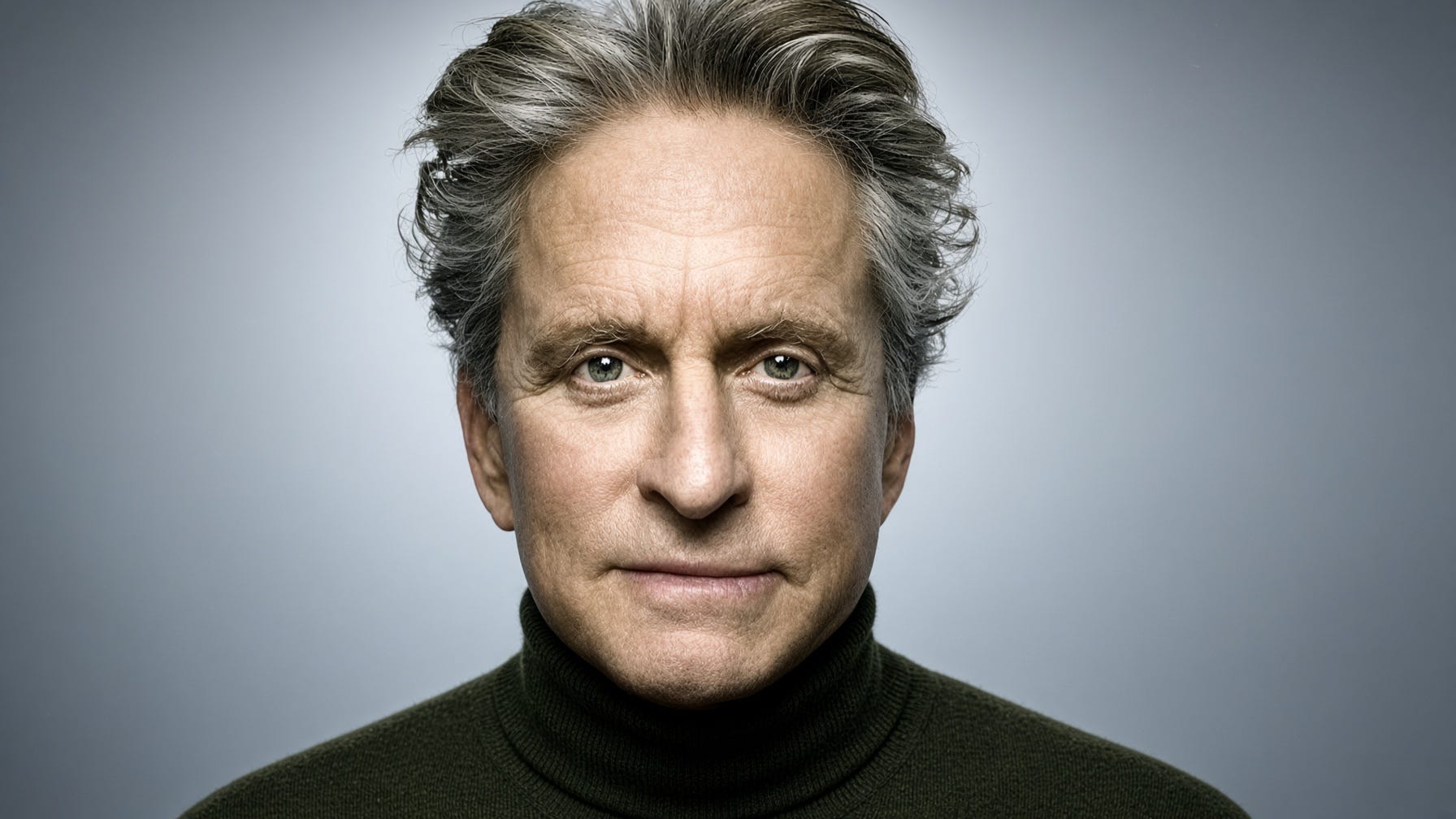
Michael Douglas has just released a memoir, “One Helluva Ride.” He’s 82 years old now and seems willing to tell all. Or at least more than most movie stars of his stature would.
And he certainly has quite a lot to tell.
He started off his journey as the son of screen legend Kirk Douglas, then found his own footing as an Oscar-winning actor and producer. He married Catherine Zeta-Jones along the way (his second attempt at marriage). And had some kids. And, of course, he also gave us Gordon Gekko. Throughout his career he saw the entire machinery of celebrity transform.
There aren’t a lot of Hollywood stars like him left these days. And the younger generation of stars inhabits a very different publicity ecosystem. They are far more cautious, heavily media-trained and rather acutely aware that almost anything they say can be clipped, posted and over-analyzed online. Or worse.
That isn’t to say that old Hollywood types aren’t guarded—they are—and they know how to play the game. Douglas certainly does. But people like him came of age in a culture where stars could still say something candid, blunt or even mildly ill-advised without having to worry that this one stray comment would be stripped of context, go viral and destroy their career.
Years ago, I interviewed Douglas about a film he had at the Toronto International Film Festival. He was truly ‘old school.’ He made sure to know my name and outlet before I came in, greeting me warmly. And then, he offered me a drink or ‘anything else’ to make me comfortable during the very short time we had together.
Obviously they were merely polite gestures. I did not expect him to fix me a martini. Though I wish I had asked just to see his reaction. Instead, “No thank you,” I replied, “But that’s very nice of you to ask.”
“Well, I’m a very nice guy,” he responded.
I immediately pointed out that a nice guy wouldn’t say that.
Then things went a little sideways.
Interestingly, in many people’s minds Douglas has become almost synonymous with playing bad guys. In reality, however, he hasn’t played nearly as many as you might think. But you can be forgiven for thinking otherwise, given just how long Gordon Gekko’s iconic shadow has loomed over his career.
“Everybody likes to play the bad guy,” Douglas told me, “because it’s more fun to play.”
“You vicariously get to do things that other people would love to do. You get to be bad. And the realities we all attempt in life give the best impressions. Why are some ladies attracted to bad boys? Why do some guys like bad girls? There is an element of danger, there’s an element of unpredictability and it’s fun to play.”
Douglas certainly doesn’t shy away from Gekko. “Gordon Gekko was one of the best parts I’ve ever had,” he declared. “It’s certainly one of the top three.”
And, of course, it won him an Oscar, didn’t it?
“And that became kind of an archetype, Gekko and all of that whole culture,” Douglas told me. “So anytime you go near that area, it’s natural that it should be brought up, but it’s not that I’ve done it so many times. It’s just that I’ve done it effectively.”
He has a point. Some performances become so culturally indelible that they begin to swallow the actor who created them. Gekko became bigger than Wall Street. The slicked-back hair, the suspenders, the “greed is good” philosophy—all of it became shorthand for a particular kind of American ambition and excess.
Of course, nobody likes to think of themselves as the “bad guy” while playing one. Or, for that matter, while doing anything else.
“No, you don’t think of yourself, you just think about what your mission is,” he responds, “You just assume that the screenplay is good and [as] you’re playing your role it kind of clarifies itself.”
That idea of moral ambiguity runs through much of Douglas’s career. He likes thoughtful films.
“It’s like a restaurant,” he explains. “You’re hungry. There are fast food [joints]...you can get two hours of entertainment and walk out of that theater after two hours and you go, ‘Well, that was fun.’ And you get on with your life. Or, if you’re fortunate enough, you could have walked out and the movie stays with you or the ideas and thoughts stay with you.”
That, he says, is what he has generally looked for in the characters he chooses.
“So, yeah, I like food for thought, given the cost of making movies, rather than the fast food.”
Douglas has played so many characters that are difficult to categorize in simple terms. Ambitious and charismatic, damaged and selfish, powerful yet vulnerable. Even when they behave badly, there’s more to them. Something that we can recognize in ourselves, perhaps.
Greed, of course, seems to be at the crux of people like Gekko—not to mention plenty of real human beings around the world. So is it that wealth corrupts people? Or is it that corrupted people are simply more willing to pursue wealth because they're prepared to do whatever it takes to get it?
What comes first: the chicken or the egg?
“Well, if greed is your main motivation and purpose for existence,” responds Douglas, “if that is what drives you, just the accumulation of money, then you’ll attempt to do it—however you can—to make more of it. So it’s the Midas touch.”
All of us have a dark side or selfish cravings, but often we tuck them away in an undusted corner, fighting against those instincts. Sometimes, deep down, we want to give in.
“Yes, I believe we all have evil in us,” Douglas tells me.
“Do you struggle to do the right thing?” Douglas asks. “In most cases, people try to. In other cases, they don’t. And I like to kind of [take] those characters that audiences love to hate and then somehow seduce the audience by the end of the movie. They’re almost over on your side.”
People aren’t just all good or bad, and that complexity is what makes characters interesting. Douglas isn’t a nice guy or a bad guy either. He’s a complicated human being, like the rest of us. His willingness to let some of those flaws show is what makes his memoir more interesting than some carefully polished version of his life that reads like a press release.
Want to support my work? Here’s how you can help:
Consider becoming a subscriber (and enjoy a week of premium for free!)
Share my posts and Substack with people who might enjoy it. Liking and commenting also helps more people discover my essays!
Make a one-off donation via Buy Me a Coffee
Pick up a copy of my book, No Apologies: How to Find and Free your Voice in the Age of Outrage
Falling Down was my favorite film followed by War of the Roses.
Enjoyed this. It's his bad guy roles that have stayed with me. Not just Gekko but the adulterer in Fatal Attraction and the guy in Falling Down.