
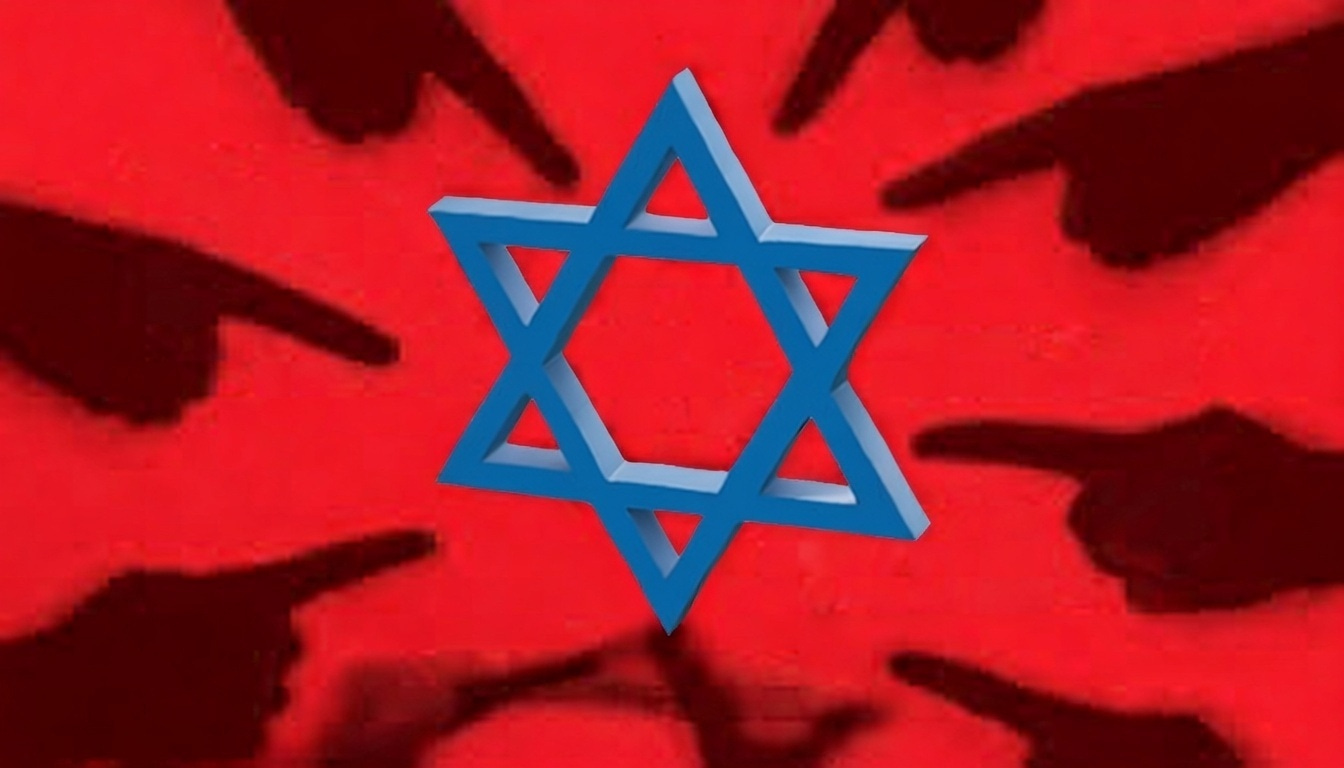
My experience with antisemitism
My parents grew up in the Soviet Union, where they experienced both systemic and social discrimination. In a system where all animals were equal but some were more equal than others, many doors closed before you could even reach the handle. No amount of vodka could erase that. They left, in large part, because they saw no future there for their child. Me. They knew that with the word “Jewish” stamped on my birth certificate, my options would be limited—no matter any talents or ambitions I might have. They also valued and dreamed of freedom. That’s what the West represented for them at the time. It was not merely geography, it was an idea.
As a child, I spent several years in Israel. At the time, that was the only country my family could escape to—the only one willing to accept them. They left with nearly nothing. Ironically, I don’t think I really grasped the idea of being “Jewish” while living in Israel—perhaps in part because I was too young for that conceptualization, and perhaps because it was hard to make sense of. There was such a variety of people there, and we were all sort of united by holidays and traditions. I didn’t really think about it much.
When I moved to Canada, I wasn’t yet a teen. But I felt conspicuously different in ways I could not quite articulate. I hyper-focused on fitting in. I could speak fluently thanks to a very good ear and an American language tutor. But this did not translate into belonging. I felt a bit like an alien trying pass as human. I perceived myself as looking different, having a different background…being different. I wasn’t very good at fitting in, but for a time, I tried.
After years in the desert sun, my skin was darker than that of many of the people around me. I fixated on lightening it, on becoming paler, more porcelain. I avoided clothing that hinted at anything I feared might be read as ethnic. I am embarrassed by this now, but that was my reality—shameful as it is.
I struggled to conceptualize what a Jewish ethnicity was. Unlike many people on the Internet, I was quite aware that being Jewish was not merely a religion—my household was Jewish, but not religious, growing up.
I later realized that this isn’t something all that atypical. For example, having studied Scottish culture in a university course, I found many literary references searching for identity in the same way I have been: Who are we? Where did we come from? What defines us beyond stereotype? The Scots, too, wrestled with caricature—red hair, fiery tempers—despite being, more often than not, dark-haired and pale, olive and brown. They, too, catalogued their poets, their inventors, their thinkers, and actors—proud of achievements disproportionate to their numbers. The more I looked, the more surprising parallels I saw. The truth is, a lot of cultures have far more similarities than people think—but they don’t know unless they get to know them on a deeper level.
I learned to accept myself around the same time I learned to stop caring what people I did not care about thought of me. This was university. The cliques dissolved. No one noticed how many friends I had or which fashion trends I followed. I kept only those who mattered to me. A few became lifelong friends. The rest became background.
My early encounters with antisemitism were subtle: a joke here, an awkward stereotype there. Nothing overly dramatic. Online, of course, I saw hatred in its raw form, but it felt abstract, the way distant storms do when you are dry and indoors. I regarded the haters with a kind of anthropological detachment. People so consumed by hostility toward strangers based on their ethnicity struck me as pitiable, not powerful. I did not respect them, so why should their words hurt me or be taken seriously? They were irrelevant.
Then, as a teenager, I was volunteering somewhere when a supervisor—someone who I had spent days with in deep conversations and grew fond of—referred to me as a JAP. I had never heard the term before. I went home and looked it up. Jewish American Princess. A demeaning slur that paints Jewish women as spoiled, entitled, privileged. The assumption that I was rich and spoiled couldn’t have been further from the truth—especially given my history. But the label really only required one credential: Jewishness. It was a small encounter and the comment was delivered casually, but it stung because it came from someone I liked. Someone who chose to stereotype me. Years later, a colleague, drunk and emboldened, told me he had known I was Jewish right away because of my nose.
There have been other comments here and there over the years, but on the grand scale of things, things were okay. For a long time, I believed these were anomalies. Society, I thought, had moved past this. Or at least past saying it out loud.
I was wrong.
I never imagined waking up to a world in which antisemitism would feel not only common, but acceptable. Whatever one believes about the conflict in the Middle East, there is no denying that it has also become a pretext for something far older and far uglier. Hatred rarely wastes a good opportunity.
Stories accumulate. Taxi drivers on antisemitic rants. Swastikas drawn inside coffee cups and on Jewish businesses. Jewish schools targeted in repeated shootings. The Bondi Beach slaughter. These are no longer aberrations. They are dangerous patterns.
Online, on a daily basis, regardless of what I post, I’m hit with old-fashioned antisemitic messages. “You’re a Jew” memes. Pictures of ugly, conniving “Jews” with big noses (even though mine’s pretty nice, I think). Death threats. In public debates and podcast appearances, my Jewishness becomes a fixation in the comment section.
Before October 7, when I tried to speak about this escalation, I was told I was imagining things. That racism was now a fringe phenomenon. That I was overreacting. I showed some of these people examples of the kinds of things I was getting on a regular basis. The arguments stopped. On some level, I get it: if you’re not someone who surrounds yourself with racist individuals or is being targeted by them, you might not see it—at least not as much. But today there’s so much of it flooding the ecosystem that it has become impossible to deny. And it’s not merely hate toward Jews; it’s toward many other groups: Black people, Indians, Arabs, trans people, and so on. It’s all been normalized.
Hatred today wears many costumes. Toward Jews, it often dresses itself as anti-Zionism—not as a critique of a country’s policy, but as a slur with the intent to dehumanize. Zionist has become a socially acceptable synonym for Jew. Yet the tropes remain unchanged: “{{They}} control the media, the banks, the world government…we should eradicate {{them}} from society.”
Others are happy to dispense with euphemism entirely. Depending on one’s ideological leanings, Jews are blamed for immigration or for capitalism, for moral decay and for economic exploitation. Depending on the speaker, we are simultaneously too powerful and too weak, too foreign and too entrenched.
Some insist that Jews cannot even claim the word antisemitism—that they are not truly Semitic. Their linguistic game purposefully ignores history in favor of pedantry. The term was popularized in 1879 by Jew-hater Wilhelm Marr to give a “scientific” and “polite” veneer to the idea that Judaism was not only problematic as a religion, but that Jews themselves were a dangerous race. The word was invented and first used by antisemites to describe their own ideology! While linguistically imperfect, given that “Semitic” can apply to other groups like Arabs—the term has always referred in practice specifically to hatred of Jews.
We are frequently told, when we bring up cases of discrimination or violence towards Jews (while most people remain silent) that we shouldn’t “center ourselves” because elsewhere many more people are dying. Or we’re told that our “Holocaust card has run out,” though I’m unaware of any privileges attained from Holocaust “sympathy” beyond unbelievable loss, trauma, and grief. I only know that today I have a very small family when I could have had a much bigger one.
We are told, too, most comically, that we are not real Jews at all—that Ashkenazi Jews descend not from the Levant but from medieval converts, the Khazars. The theory has been discredited for decades, but conspiracy theories are not sustained by evidence. They are sustained by some people’s desire to believe in them.
We’re also told to “go back to Poland”—an interesting choice of location given that Poland was where around three million Jews were murdered in camps like Auschwitz, eliminating ninety percent of Poland’s Jewish community. (But soon, few will even know this, as Holocaust education is being quietly expunged from public school curriculums).
Meanwhile, Jews today come from everywhere: Eastern Europe, yes, but also Western Europe, Argentina, Morocco, Tunisia, Turkey, Greece, Iraq, Iran, Yemen, Syria, Ethiopia, India, and so on. And yes, we are “allowed” to do DNA tests. And yes, they confirm that indeed Levantine ancestry runs through all of us—whether we’re Ashkenazi, Mizrahi, or Sephardi. Braided in with some of the places where our diaspora has ended up throughout history.
It’s amusing—but not particularly funny—that those who hate Jews simultaneously want to erase our identity while also hating us for it.
They have even become enthusiastic readers of the Talmud—at least in quotation form. The fact that most of the quotes are fabricated or taken wildly out of context seems beside the point. The Talmud, after all, is not scripture but a collection of rabbinical arguments: centuries of disagreement preserved in ink (which most Jews haven’t even read). But nuance has never been hatred’s preferred genre.
Here’s the thing:
My feelings about such people remain intact. I am not personally wounded by these people. I do not respect them or the opinion of anyone who chooses to spread hate or judge people not as individuals but based on the immutable characteristics—whatever they might be.
But I look around, and I am sad.
I am sad that I have to write this at all. I’m sad to see how few non-Jews are willing to speak up (and am eternally grateful for those who do). I’m sad that this atmosphere feels familiar. Marx once wrote that history repeats itself, first as tragedy and then as farce. Lately, it feels as though we are staging the revival in the wrong order. (So there’s another thing he got wrong).
Too many people now find it normal to speak about entire groups of human beings as if they were abstractions, making them easy to dehumanize and hate.
There is another old saying: the Jews are the canary in the coal mine.
The sound you hear is not only our alarm.
If you found this story useful, please consider supporting my work by sharing, becoming a paid subscriber, or making a one-off donation via Buy Me a Coffee ☕️.
Also, check out my book: No Apologies: How to Find and Free your Voice in the Age of Outrage!


Katherine, I am not Jewish. But I, at times, when I see antisemitism displayed, often disguised as 'anti-Zionism,' feel the rage and disgust that you have managed to resist. You have my admiration.
I remember, as a young lad, hearing very gentle digs at Jews from my elders, and wondering why people were talking like that. As I grew and matured, I learned about things like the Holocaust and the beginnings of Israel. And learned to admire Jews as a group for their tenacity and ability to turn lemons into lemonade, or desert into fertility.
Please do know that there are truly many people that back you as best we can, even if we aren't as loud and abrasive as the others.
This was such a fine piece of writing; it moved me to become a paid subscriber.
As an (amateur) historian, I’ve long been interested in the world’s oldest form of racism. That interest derives from my study of modern German history in college and graduate school. The more I learned about Nazi Germany, the more clearly I perceived that the whole story of the Third Reich centered on eliminationist antisemitism, which was National Socialism’s master passion. Anyhow, I’ve been writing about it on Substack since I landed here in 2022. As I myself am not a Jew, my commentary has not the emotional impact of your essay. But I do think that it’s important to keep the relevant history alive—as I’ve tried to do with essays like this one:
https://unwokeindianaag.substack.com/p/antisemitism-in-america