


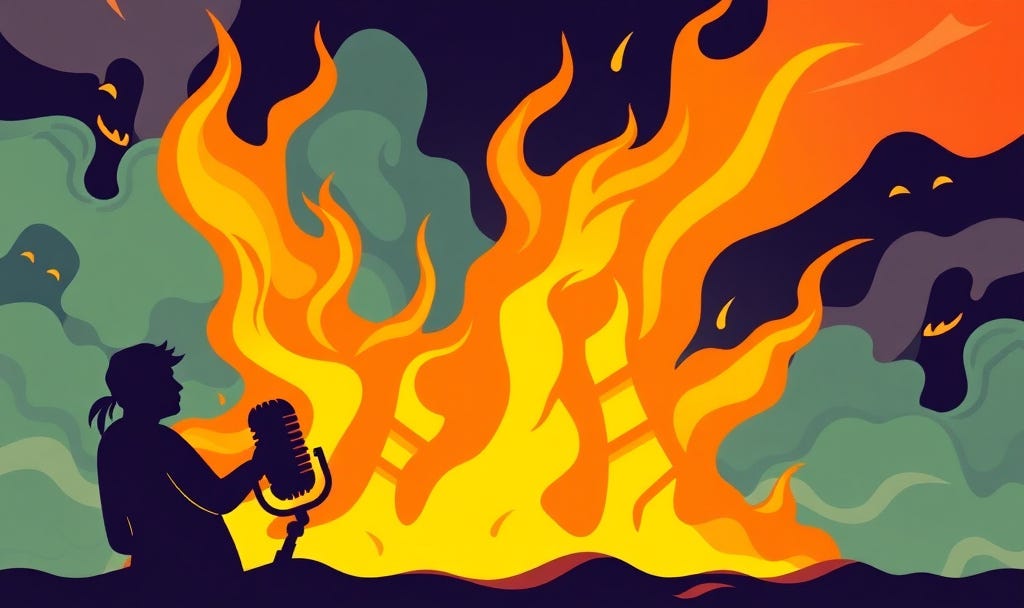
Now that I’ve gotten your attention, a disclaimer: There are indeed some great podcasts. Thoughtful, rigorous, genuine. There are some excellent independent content creators too. Even so-called citizen journalists who do better work than many legacy outlets.
On Substack, I’ve found people who write essays that are thoughtful, informed, intelligent—and even deeply funny.
But then there are the others. You know those of whom I speak.
The confident merchants of misinformation, half-truths, and algorithm-friendly outrage. And, they do rather well too.
The good, the bad, and the ugly all have access to the same “publish” button. Careful analysis, genuine insight, and outright nonsense all compete in the same feed. And studies show that false stories reach people significantly faster than true stories do—being 70% more likely to be shared and travelling at six times the speed.
The system often rewards what is emotionally-charged, not what is true.
I understand how distrustful many have grown towards traditional media. Its flaws are numerous. However, it has an inherent structure that lends itself to greater accuracy and less overall charlatanism.
There’s a process in place to reduce error. Ethical guidelines. Editors. Fact-checkers. Legal teams. There’s friction. Sometimes it’s a frustrating friction, and it doesn’t guarantee error-free reporting, but there are multiple internal checkpoints before something goes out. And a number of people on that chain to hold accountable if they get something wrong, as well as institutional long-term reputation to consider. Plus legal exposure.
None of this makes it perfect. Far from it. But it does help.
At the same time, as legacy outlets struggle economically, those editorial layers are being reduced.
And meanwhile, independent creators like podcasters, writers, and video essayists have managed to build audiences without all the filters, pressures, and restrictions. Some of these creators are far more rigorous and transparent than institutional media. Some are, frankly, better journalists in practice than certain journalists.
But that rigor is optional. It depends entirely on the individual.
Anyone has the power to publish and it’s up to the reader to discern.
So what we’re left with is a mixed media ecosystem: highly professionalized institutions on one side, highly individualized media production on the other, and everything in between competing for your attention.
And audiences don’t always distinguish between them.
Emotionally charged, sensationalist content doesn’t just compete with more thoughtful work, it often outperforms it and requires fewer resources to produce. This is because human attention is reactive. Outrage-inducing falsehoods often overshadow well-researched, thoughtful, accurate writing—spreading quicker and more vastly.
All this leaves me wondering: where are we headed?
