


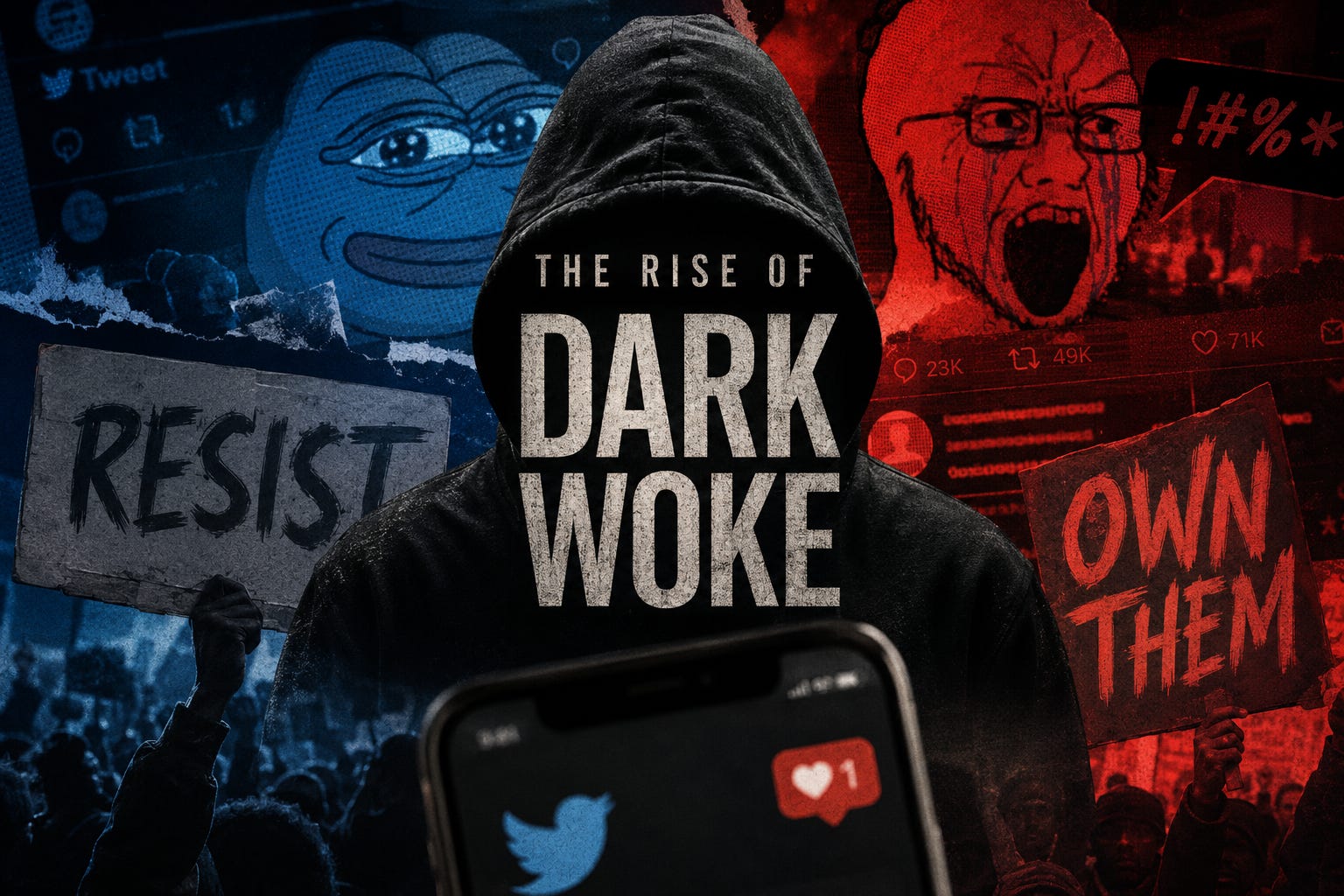
You’ve heard of “woke,” “right wing woke,” and “woke reich,” but there’s yet another kind of woke in town, “dark woke.”
All of these labels share the same DNA. They're reactionary in nature. Each one is a backlash to a backlash.
The original “woke” was a reaction to social injustice, like racism, inequality, and discrimination. It was initially about being alert to these things, but over time the meaning broadened to mean all sorts of different things—positive and negative, depending on who you ask and what mood they happen to be in.
The “Right Wing Woke” (which I had previously written about here) flipped things around. It took the grievances and victimhood that the right had spent years mocking on the left and rebuilt it in their own likeness: virtue signaling, moral absolutism, social enforcement mechanisms, cancel campaigns, and tribal loyalty tests—just aimed in the other direction.
“Woke reich” narrowed the target further, used mainly to describe a slice of the right accused of flirting with extremism, isolationism, and antisemitism.
Enter “Dark Woke”
But yet another variation has emerged: Dark Woke.
Although this phenomenon isn’t some formal ideology, it has been predominantly embraced—informally—as a communication style by progressive commentators and figures in a highly polarized environment. It’s a more cynical, combative style that rejects traditional liberal politeness in favor of aggression and meme-driven confrontation towards those that they view as their political opponents.
But even that is a sequel of sorts, often compared to the “dirtbag left”—a phrase coined in 2016 by writer and Chapo Trap House co-host Amber A’Lee Frost to describe a strain of socialist politics that treated politeness as a tactical liability rather than a virtue. Vulgarity, Frost argued, is “the language of the people,” and the left should be willing to use it. This style of political discourse consists of irreverent and crass humor, anti-establishment rhetoric, frequently used to skewer establishment Democrats/centrists and even aspects of activist culture, not less harshly than conservatives.
However, while the dirtbag left was more explicitly rooted in economic populism and class analysis, “dark woke” is perhaps better viewed in the context of being a direct response to the Trumpian politically incorrect style employed by MAGA.
Indeed, the hashtag #darkwoke started circulating on X around Donald Trump's second inauguration, with left-leaning accounts sharing memes that gleefully imagined Trump supporters' comeuppance.
Soon Democratic candidates were encouraged to use a more combative, profanity-comfortable rhetoric to win back voters drawn to Trump's bombastic style.
Democratic communications consultant and former digital director for the Wisconsin Democratic Party, Bhavik Lathia, told the New York Times: "Republicans have essentially put Democrats in a respectability prison."
She continued: “There is an extreme imbalance in strategy that allows Republicans to say stuff that really grabs voters’ attention, where we’re stuck saying boring pablum. I see this as a strategic shift within Democratic messaging — I’m a big fan of ‘dark woke.”
California Gov. Gavin Newsom’s launched a meme warfare campaign, engaging in Trump-style trolling.
Instead of the high road: persuasion, compromise, "finding common ground," under “dark woke” the goal is to out-dominate the other side. Outrage gets met with bigger outrage. Insults get answered with sharper insults—and memes. The political correctness the left once policed gets thrown out the window too. If certainty, anger, intensity, resentment, and cruelty are what’s winning on one side, deploy the same toolkit on the other side.
“The idea is to subvert the qualities that people think made wokeness cringe—the virtue policing, the polite ‘when they go low, we go high’ posturing—and go Joker Mode to Make Democrats Cool Again,” writes GQ’s Kieran Press-Reynolds.
When your audience has been desensitized to the point that they respond to shock value over nuance, where else can you go?
The central thinking is this: If your opponents have spent a decade getting rewarded for cruelty, refusing to be cruel back just means losing politely.
As with many movements, it is justified since it’s for the greater moral good.
The Strategy: Out-Cruel the Opposition
Is it an effective political tool? Probably. Stepping outside of political correctness was part of Donald Trump’s appeal with many of his voters. Crass is seen as authentic. So is trading insults, not holding back. The “dark woke” are simply embracing that for their own ends.
Perhaps it’s also appealing to those observing because it gives them a sense of empowerment: “Aha! He really told him off.” They live vicariously through the insults they might be thinking but are perhaps unable to deliver directly. That’s energizing for supporters.
“The other side did it, so now they get a taste of their own medicine,” is a sentiment I’ve often heard echoed on the right spectrum. Now the same is being spoken by the left. Ultimately, this is less ideological than psychological. It’s about power, ridicule, anger, and revenge.
Attention vs. Action
But while outrage is good at getting attention, it won’t get people to act: naming the villain will.
A 2021 PNAS study analyzing over 2.7 million social media posts found that the strongest predictor of how far a post traveled wasn’t emotional language, but rather naming and attacking a political out-group. Another recent study tracked over a million posts linked to nearly 25,000 Change.org petitions and found that posts expressing moral outrage tended to go more viral, but didn’t make a particular difference to whether anyone actually signed the petition being promoted.
The findings stated that in “expressions of agency, group identity, and prosociality were associated with more signatures but no more virality.”
The Cost
But when you name your enemy and target them as such, dehumanization cannot be avoided. It is difficult to strike as hard as “dark woke” seeks to without flatten them into a caricature first. It’s a necessary coping mechanism for those intent on delivering blows.
But, of course, all of this simply leads to escalation and greater polarization, which—after it reaches a certain point—it might be impossible to come back from. We can end up in a state of permanent hostility.
Research consistently shows that as people become more ideologically divided, not only do they become more distant and dislike each other more, we are more likely to “participate in extreme forms of outgroup derogation.”
The Feedback Loop
Throughout history, reactionary movements have often absorbed the traits and tools of their adversaries, creating a sort of self-perpetuating loop: defeat your opponent by becoming more like them. If they don't resemble their opponents in ideology, they often come to resemble them in behavior. Even movements of counterculture eventually curdle into their own brand of conformity. Anti-establishment movements build their own establishments.
And, as they say, if you fight fire with fire, eventually everyone gets burned.
Means, Ends, and Tradeoffs
Proponents of the “dark woke” approach view responding to aggressive tactics with polite discourse as a failure. The Michelle Obama sentiment of “when the go low, we go high” is seen as ceding ground, a naive approach. If someone is pointing a gun at you, the thinking goes, you don't talk, you point one back. And be willing to shoot first.
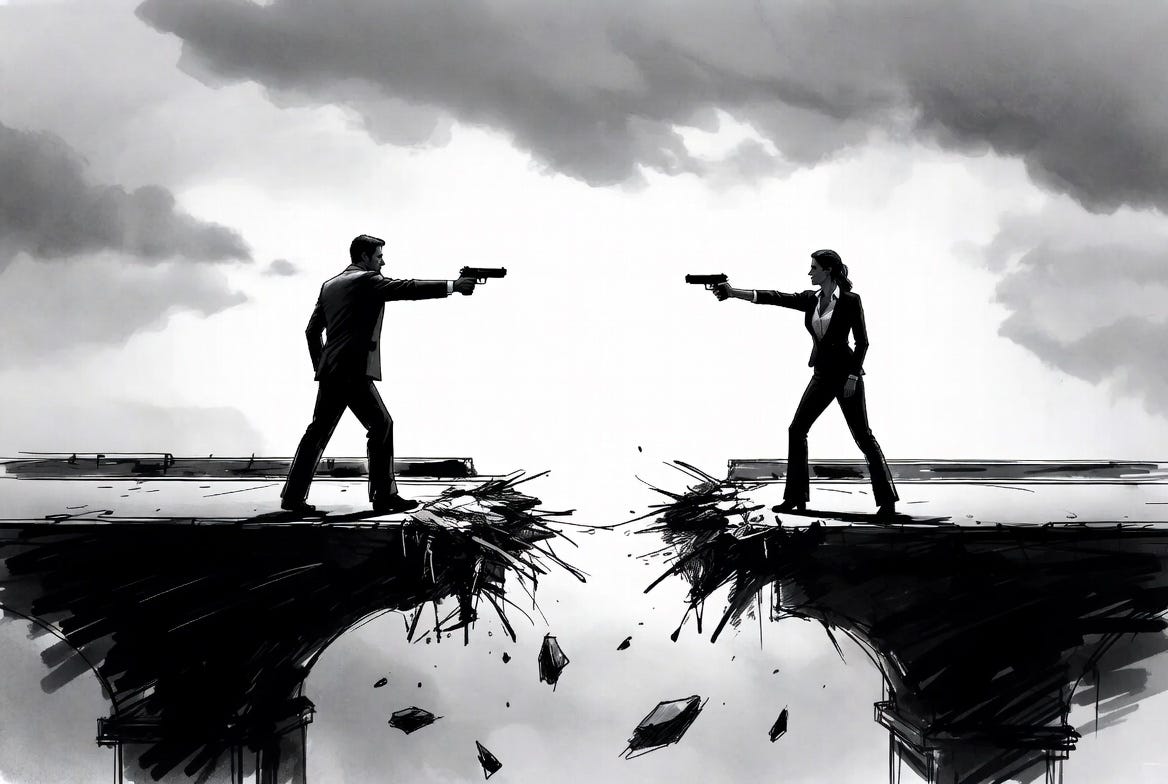
But do the goals matter less than the methods by which they are achieved? If you abandon the moral high ground to win, what exactly have you won besides the power itself? If you adopt your opponent’s rules, methods, and cruelty, what’s left to distinguish you from them—besides which letter follows your name on the ballot?
The two sides don't want the same things, and that's an important distinction. They are not interchangeable. But these questions aren't about which goals deserve to win. They're about what you become once you reach for corrosive methods to get there.
Is it possible to win without doing any of this? It’s hard to know. Although for years, in many countries, parties have won and lost elections without…going low. It seems possible, even if the current climate has shifted.
But ultimately “dark woke” rests on a quieter assumption about the people it’s trying to mobilize: that winning matters to them more than how the game gets played. That might be true. It’s also exactly the bet the other side already made.
Want to support my work? Here’s how you can help:
Consider becoming a subscriber (and enjoy a week of premium for free!)
Share my posts and Substack with people who might enjoy it. Liking and commenting also helps more people discover my essays!
Make a one-off donation via Buy Me a Coffee
Pick up a copy of my book, No Apologies: How to Find and Free your Voice in the Age of Outrage
Want to advertise in this newsletter? Reach out.
Power is the end-all, be-all for activists on the polarities. Always has been. They don’t care about the downstream societal effects of dehumanizing rhetoric as long as when the dust settles, they're the ones setting the agenda.
It’s all form over substance. It’s a distraction from democrats doing the real work of actually figuring out why people don’t vote for them and fixing their platform.