
The sordid tale of a Victorian beauty guru
The search for the fountain of youth has been ongoing throughout history. Today, we’re inundated with products and services that promise to make us ten years younger, put the bounce back in our skin, and make us impossibly attractive—if only we buy that one miracle product for our medicine cabinet or makeup drawer. And if that’s not enough, there are chemical peels, fillers, Botox, and even vampire facials.
Everyone seems to be selling something designed to make us prettier and younger. Beauty influencers dominate TikTok, YouTube, Instagram, and magazines. Some of their advice is genuinely helpful, some of it is questionable, and all of it is meant to part you from your hard-earned money.
But Madame Rachel had them all beat.
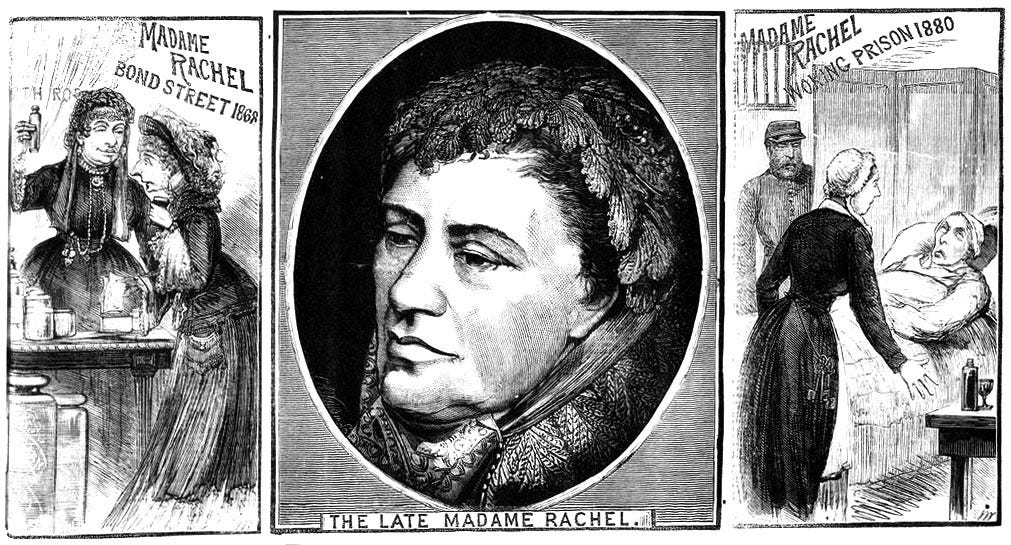
Born Sarah Rachel Russell, she became the most infamous Victorian-era “beauty entrepreneur” and con-woman in 1860s London.
Her luxurious Mayfair salon—“Madame Rachel: Enameller to the Queen and the Aristocracy”—promised to make women “beautiful for ever,” at a time when the natural look was in vogue. The ultimate “no-makeup makeup” belonged to the Victorians: visible cosmetics were socially frowned upon, thanks largely to Queen Victoria herself. Heavy makeup was associated with prostitutes, actresses, and the lower classes (who likely needed a bit more help in that department, given their far less leisurely lives).
Yet, just like today, imperfect natural beauty wasn’t actually the standard. Victorian ideals prized delicate purity: long, flowing hair, a tiny waist, and a porcelain complexion. Not everyone was naturally blessed with these traits—or able to maintain them with an expensive regimen. Cheek-pinching and lip-biting didn’t cut it for most.
So many Victorian women enhanced their appearance in secret—sometimes with dangerous concoctions such as white lead powder, arsenic wafers, belladonna, and zinc-based products.
This is where Madame Rachel entered the scene. She claimed she could make women beautiful—at a price. Her brand was that of a mysterious Arabian woman trained in the ancient beauty secrets of the East. In reality, she had never left Britain. She also falsely claimed royal patronage. Her shop was opulent—marble, gold, rich fabrics—creating an irresistible fantasy. Today, we’d just call it branding.
Her treatments included Arab Bloom, Circassian Golden Hair Wash (honey mixed with cheap dye), Jordan Water Baths (scented London tap water), and “Magnetic Rock Dew Water from the Sahara,” which supposedly erased wrinkles overnight. Her signature youth-restoring service, “permanent enamel,” was essentially white lead mixed with arsenic—painted directly onto the skin.
Young women were especially eager to make the most of their looks, as their futures depended on securing a husband. Older women were just as motivated—hoping to preserve their beauty and maintain their husbands’ attention in the face of younger rivals. And of course, there was always vanity.
Madame Rachel’s services weren’t cheap. Beauty rarely is. Her prices were steep, and her clientele was wealthy and often desperate.
But behind the gilded façade, something far darker was happening. Madame Rachel didn’t just sell beauty; she offered a sympathetic ear to middle-aged society women who confided in her about their affairs, debts, and family scandals. Her products were shoddy imitations made from cheap ingredients, and she kept meticulous notes—not to improve her formulas, but to blackmail her clients. She threatened to expose their secrets unless they purchased more treatments or paid exorbitant “loans.” She even threatened to tell their husbands they used her services, knowing cosmetics were socially taboo.
In 1868, she was convicted of defrauding a widow, Mary Tucker Borradaile, and sentenced to prison. She was arrested again in 1878 for similar schemes. Madame Rachel died in prison in 1880, but her sensational trials captivated—and scandalized—the Victorian press.
In the end, Madame Rachel didn’t make anyone “beautiful for ever”—but she did prove one thing: the beauty industry has always been built on hope, fear, and a very good sales pitch.
A century and a half later, her treatments may be gone, but her business model lives on. Different packaging, same insecurities.
PS. Someone should make a movie about her story.
If you found this story useful, please consider supporting my work by sharing, becoming a paid subscriber, or making a one-off donation via Buy Me a Coffee ☕️.
Also, check out my book: No Apologies: How to Flind and Free your Voice in the Age of Outrage!
Support independent journalism. Consider becoming a free or paid subscriber.


This really does deserve a movie... Of course back in the day products were sold with ingredients that would astonish or horrify us today... as when Coca-Cola literally had cocaine in it (it's still made using coca leaf extract) and 7-Up had the mood-stabilizing drug lithium in it until the late 1940s... as for fountain-of-youth beauty treatments, you should patent one of your own, as whatever you're doing, it's working beautifully!
Very interesting story! Where can one learn more about her? Do you know if she had influence outside of England?
We've definitely not evolved out of doing ourselves visible and invisible harm to meet a constructed and exploitative beauty standard.