


I tend to reference Breakfast at Tiffany’s a lot—and for good reason. It isn’t some frivolous film. It was adapted from a novella by Truman Capote and adapted to the screen by screenwriter/playwright George Axelrod (The Seven Year Itch, The Manchurian Candidate). It’s a serious work, one that has a lot to say about the human condition—an affliction we all suffer from, whether we choose it or not.
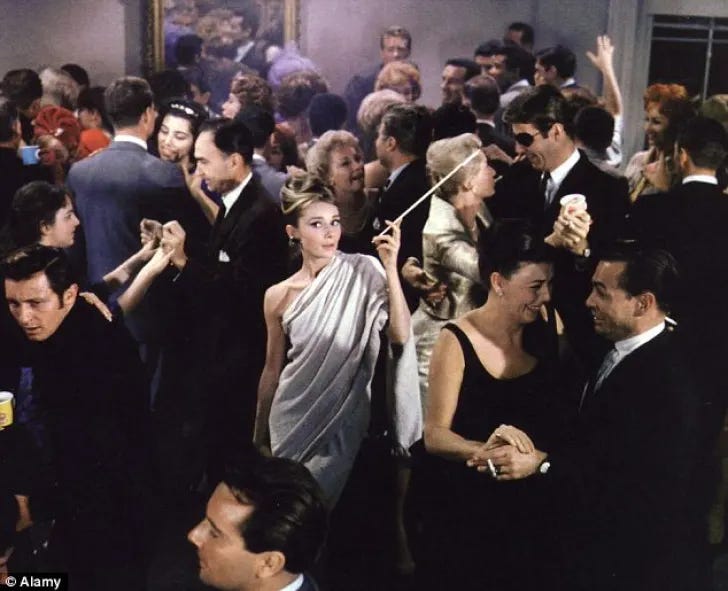
The scene that has always stayed with me is the party.
It’s loud, chaotic—full of people, laughter, music, drinking. On the surface, it feels alive as the camera moves around. Holly appears to be at the center of it all. Socially, she’s got it made.
And yet, something feels deeply unsettling.
As Holly drifts from one stranger to the next, never quite settling, you begin to feel what’s missing: real connection.
Holly is surrounded by people, but she is utterly alone.
Her presence is a kind of performance. She’s magnetic, charismatic—but distant. Because she never stops performing, she never allows h…
