
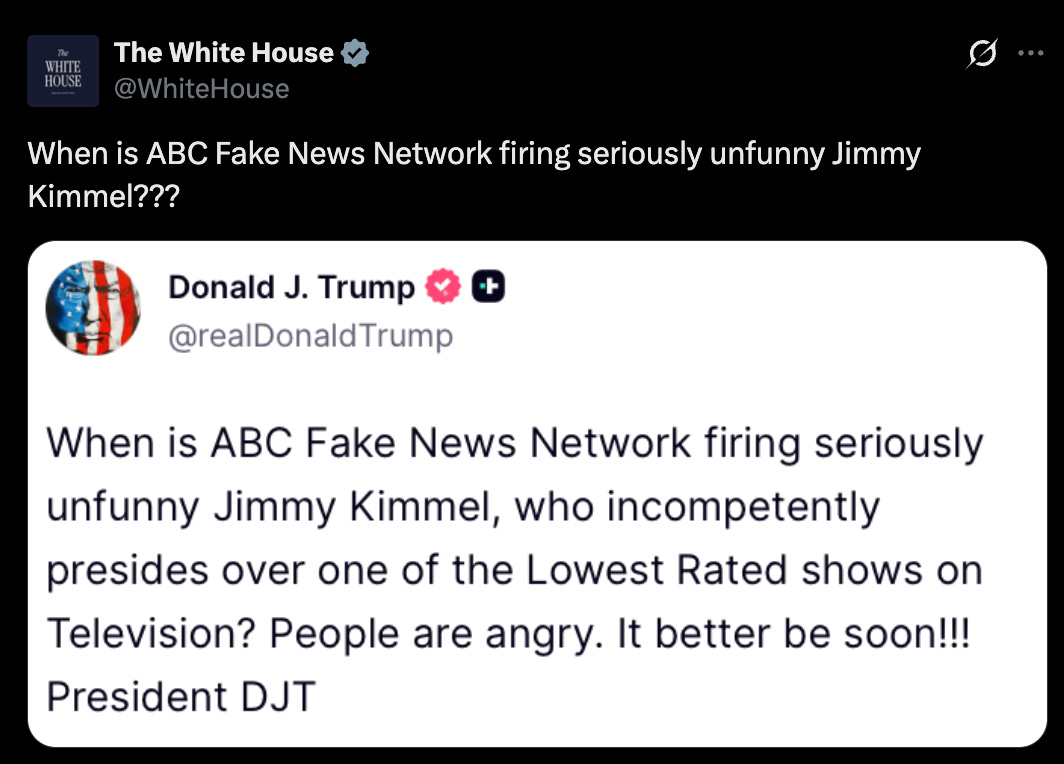
Trump's war on Kimmel
If you’re not fully caught up on recent events: Recently, Jimmy Kimmel staged a faux White House Correspondents’ Dinner roast on his show. He made a joke about the First Lady, Melania Trump having “a glow like an expectant widow.” For context: This happened several days before a shooting attempt at the real dinner.
The First Lady, outraged, called for his firing. Then Trump echoed her sentiments, telling ABC to get rid of him.
Then the FCC ordered an early license renewal for ABC stations.
As they say, in comedy, it’s all about the timing. But also in real life.
This is not the first time that FCC Chairman Brendan Carr has stepped in.
What surprised me wasn’t the administration’s response so much as the reaction from so many others. Trump and the First Lady are entitled to free speech, the crowd chanted. And it’s true. They are. But this had gone far beyond merely criticizing Kimmel for a joke they didn’t like. They called for his firing. And who speaks for the government if not the president?
This isn’t on par with the criticism of the average person. When Trump tells a media organization to fire someone, it carries the weight of an entire administration.
And yet many of the same people who were up in arms over the Twitter Files—where government “suggested” certain content deemed harmful is removed—and cancel culture, were now fierce defenders the President openly demanding a television host be fired.
You might think the joke was in poor taste, mean-spirited, or cruel. Worse, you might think it wasn’t funny. But as is often echoed, free speech protections aren’t just for the speech you like.
Kimmel explained the joke on his show:
“It was a pretend roast. I said, ‘Our First Lady, Melania, is here. Look at her. So beautiful. Mrs. Trump, you have a glow like an expectant widow.’ Which obviously was a joke about their age difference and the look of joy we see on her face every time they’re together. It was a very light roast joke about the fact that he’s almost 80 and she’s younger than I am. It was not, by any stretch of the definition, a call to assassination, and they know that. I’ve been very vocal for many years speaking out against gun violence in particular.
“But I understand that the First Lady had a stressful experience over the weekend, and probably every weekend is pretty stressful in that house. And also, I agree that hateful and violent rhetoric is something we should reject. I do. And I think a great place to start to dial that back would be to have a conversation with your husband about it... because, by the way, I also should point out: Donald Trump is allowed to say whatever he wants to say, as are you, and as am I, as are all of us. Because under the First Amendment, we have as Americans a right to free speech.”
Legally, Trump calling for Kimmel’s firing probably doesn’t constitute a First Amendment violation on its own. Presidents can speak. They can criticize. They can even be petty about it. That said, one could argue that calls for someone’s firing coming from the highest office in the country may undermine the spirit of free speech, even if they do not violate its letter.
But the law gets more complicated when government pressure is used to coerce or punish private parties for speech. Courts have found such pressure unconstitutional before. The FCC’s immediate move to order an early license renewal for ABC stations may be an indication of exactly that.
The FCC cited other regulatory reasons—connected to DEI practices (which brings up its own set of legal issues)—but the timing of it seems more than coincidental, especially given that the licenses weren’t due for renewals until 2028 at the earliest, with some not due until 2031. The move has been widely called unprecedented. The FCC controls broadcast licenses, which are essential for networks like ABC, so it has real leverage.
It comes across like a warning to other networks: behave — or else.
In a statement, Jameel Jaffer, executive director at the Knight First Amendment Institute at Columbia University, stated:
“The FCC has no authority to cancel broadcasters’ licenses because of their perceived political views…But this isn’t just about the rights of Disney and ABC. President Trump is trying to consolidate control over what Americans see and hear on the radio, television and social media. If he gets his way, we’ll have only government-aligned media organizations that broadcast only government-approved news and commentary. It would be difficult to imagine an outcome more corrosive to democracy or more offensive to the First Amendment.”
It’s also worth noting that FCC Chairman Brendan Carr contributed to the Heritage Foundation’s Project 2025 policy blueprint on communications, which calls for stronger presidential control over independent agencies like the FCC and recommends more aggressive use of regulatory authority over communications and tech sectors.
When it comes down to it, those who didn’t share my concerns are right on one key point: criticizing Kimmel is indeed within Trump’s rights, and even calling for his firing likely falls within the bounds of protected political speech—even if not the spirit of it.
But the FCC putting ABC's licenses under early renewal the day after Trump called for Kimmel to be fired? That's where this veers into potentially unconstitutional territory—retaliatory, coercive, and a threat to First Amendment values.
Even the perception of such conduct alone can have a chilling effect on speech, underscoring the fragile boundary between political rhetoric from public officials and how it can cross over into political pressure.
If you found this story useful, please consider supporting my work by sharing, becoming a paid subscriber, or making a one-off donation via Buy Me a Coffee ☕️.


