


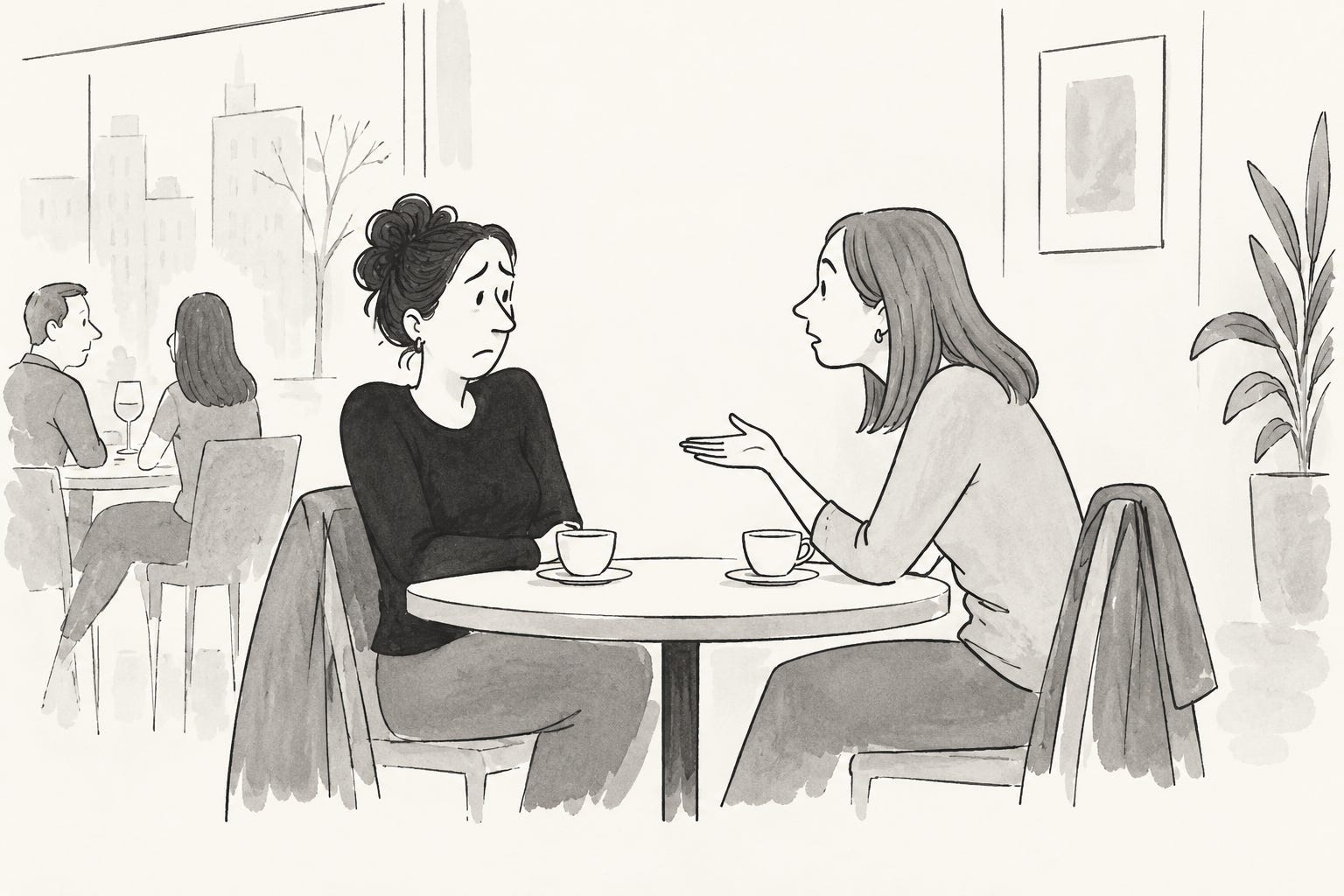
The other day, someone I had just met just minutes earlier, decided to inflict a deeply personal question on me. It was intrusive, inappropriate and entirely unprompted. But the incident also got me thinking: Why do some people feel so comfortable crossing social boundaries by asking questions that are pretty much none of their business?
Now I realize that what’s considered inappropriate in one culture may be perfectly normal in another. But I’ve found that the people who tend to ask me these kinds of questions don’t generally come from cultures where such directness is the norm.
So what’s driving that impulse? Are these people genuinely oblivious to social boundaries, or are they deliberately trying to make others uncomfortable? Could it be a way of asserting dominance? A test of how much they can get away with? A sense of entitlement?
“Asking questions is how we create connections, learn more about each other, and create intimacy in relationships,” says Dr. Carolina Estevez, PsyD, a Psychologist at Soba, a treatment center in New Jersey. Most people, she explains, can discern which topics are appropriate to discuss with whom by getting a read on the relationship, setting, and social cues. Others genuinely struggle to read the room. But for some, she says, “[they] may treat invasive or deeply personal questions as a test of how much access the other person will give them.”
There can also be a more narcisstic element at play. “Some do it simply to satisfy their own curiosity without caring about the consequences,” Dr. Estevez explains.
Whatever the motivation happens to be, invasive questions tend to catch us off guard. And that, Estevez says, can make them particularly tricky to navigate. “Due to the unexpected nature of the question, and the fact that many people are raised and socialized to be cooperative and polite, sometimes answering feels like a better solution than refusing and being in an uncomfortable or awkward situation,” she says.
There’s something rather curious about that dynamic. Even though it’s someone else who had created the awkward situation, too often it is the person on the receiving end who somehow is left feeling responsible for resolving that discomfort.
In a way, invasive questions can be viewed as an invasion of privacy. Stephanie Lewis, a long-time therapist and VP of Clinical Operations of Epiphany Wellness, a network of addiction & mental health treatment centers, argues that invading someone’s privacy doesn’t always require hacking into their personal data. It can be done through subtler means: “like asking continually bolder and more invasive questions as a conversation progresses.”
This can also become a form of controlling behavior, particularly in public or group settings. As Lewis explains, the person being questioned is “forced to defend themself or reduce the tension by answering the question, even when they don’t want to.”
Of course, not everyone who asks an intrusive question has some sort of ulterior or nefarious motive. Most people are simply curious, socially clueless, and perhaps don’t consider certain subjects to be as private as we might. They often don’t even realize their question has crossed a line. If they did, perhaps they’d reconsider asking.
But it’s just as interesting—if not more—to understand why it is that we feel compelled to answer? Why does refusing to share something personal sometimes feel more uncomfortable than sharing it despite not wanting to?
Couldn’t we simply respond with: “Sorry, I’d prefer to keep that private” or “That’s a bit too personal for me to talk about right now.” Neither response is actually rude. And yet many of us hesitate to set those boundaries. Why? Is it because we’re afraid to appear unfriendly? Guarded? Difficult? Are we afraid that if we refuse to share they will view it as a rejection of their desire to connect?
Why do we worry that setting a boundary will cause discomfort? And, more crucially, why is it that we feel responsible for sparing someone the discomfort of being told they’ve asked an inappropriate question, even when they’re the one who put us in that predicament to start with?
Perhaps part of the problem is that we’ve been conditioned to prioritize other people’s feelings over our own. We’d rather betray our own privacy than create awkwardness for someone else.
But being asked a question doesn’t mean that we owe anyone an answer.
How many times have you answered a question you didn’t really want to answer? And how did you feel afterward?
No one is entitled to your story just because they’re curious enough to ask.
Want to support my work? Here’s how you can help:
Consider becoming a subscriber (and enjoy a week of premium for free!)
Share my posts and Substack with people who might enjoy it. Liking and commenting also helps more people discover my essays!
Make a one-off donation via Buy Me a Coffee
everything you said and everything I read fromm the "experts" you quoted is dead on.
One thing I found missing though is this; If it happens just once or rarely it can be written off as one or all of the above. But if a person finds themselves frequently in that scenario, they have to stop and figuratively look in the mirror.
In my experience when it is a frequent occurance The person is subtly and many times unconsciously inviting the intrusive question.
As to the 2nd part, the conundrum you mentioned that people may find themselves in when asked an intrusive question. I have no insight on because as you once replied "I am more direct"
I literally have no problem answering most of the time, You wanna know about what it is like being smoged? ask (its better not ask it is horrendously and nightmarishly gross🤣). I'll tell ya, I don't care. I am pretty much an open book.
If I do care and I deem it intrusive I answer by saying that is none of your business— most often I will be kinder by saying You will never know because because I ain't telling you.
I am blessed to not have one blink of angst over telling someone to pound sand.