


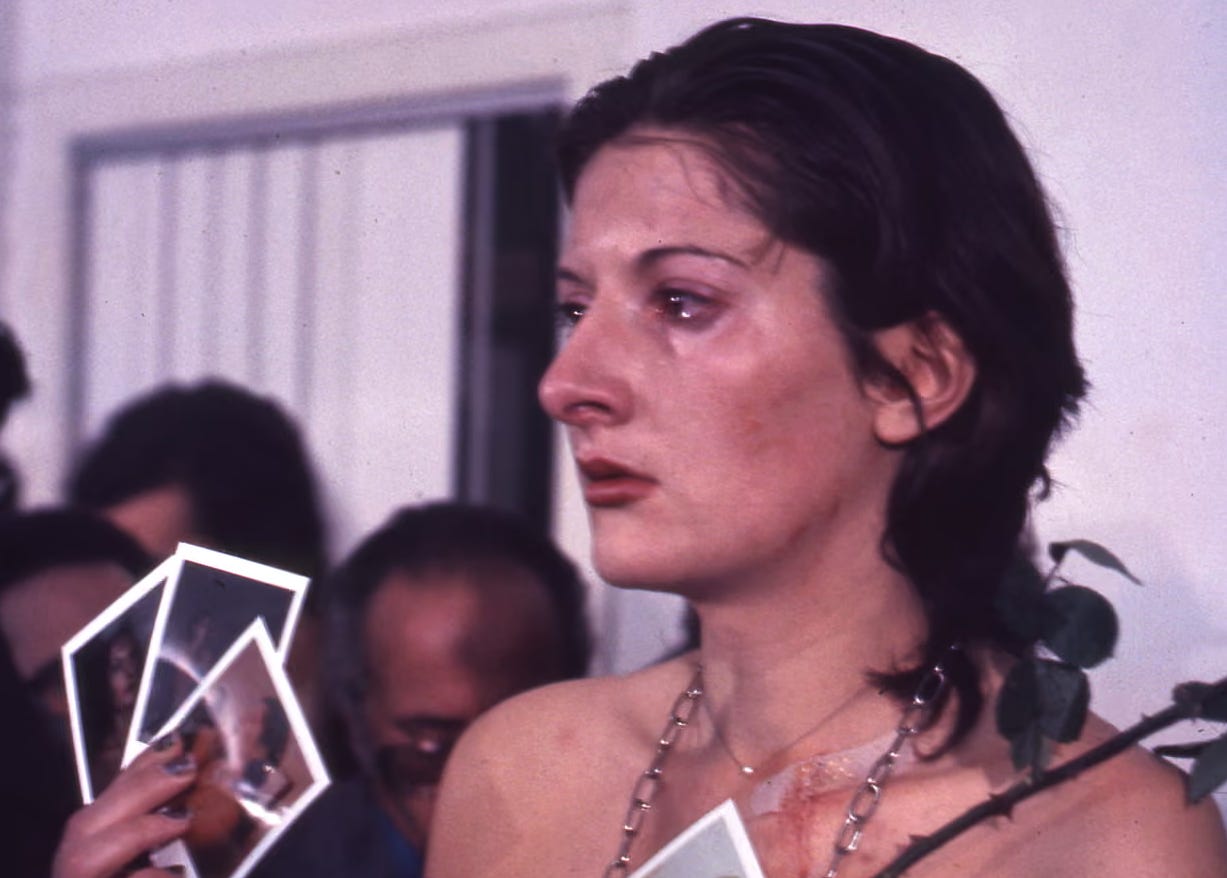
In 1974, a performance artist in Naples, Italy stood passively for six hours while the ‘audience’ could use a range of 72 objects on her in whichever way they wished. She would not resist, for these six hours she’d surrender her own agency to the crowd and take responsibility for anything that happened. She’d remain completely passive.
She left written instructions: “There are 72 objects on the table that one can use on me as desired.” And, “I am the object.”
The artist was Marina Abramović and the piece was called Rhythm 0.
But perhaps it is best viewed through the lens of a social experiment of sorts—decades before the MrBeast era.
Of the objects provided there was quite a range.
Some were benign: A rose. Honey. Bread. Apple. Comb. Lipstick. Cotton. Flowers. Mirror. Brush. Wine. Book. Perfume. Polaroid camera.
Others, less so. Whip. Pocket knife. Chains. Nails. Kitchen knife. Saw. Hammer. Axe. Razor blades. And finally, a gun and bullet.
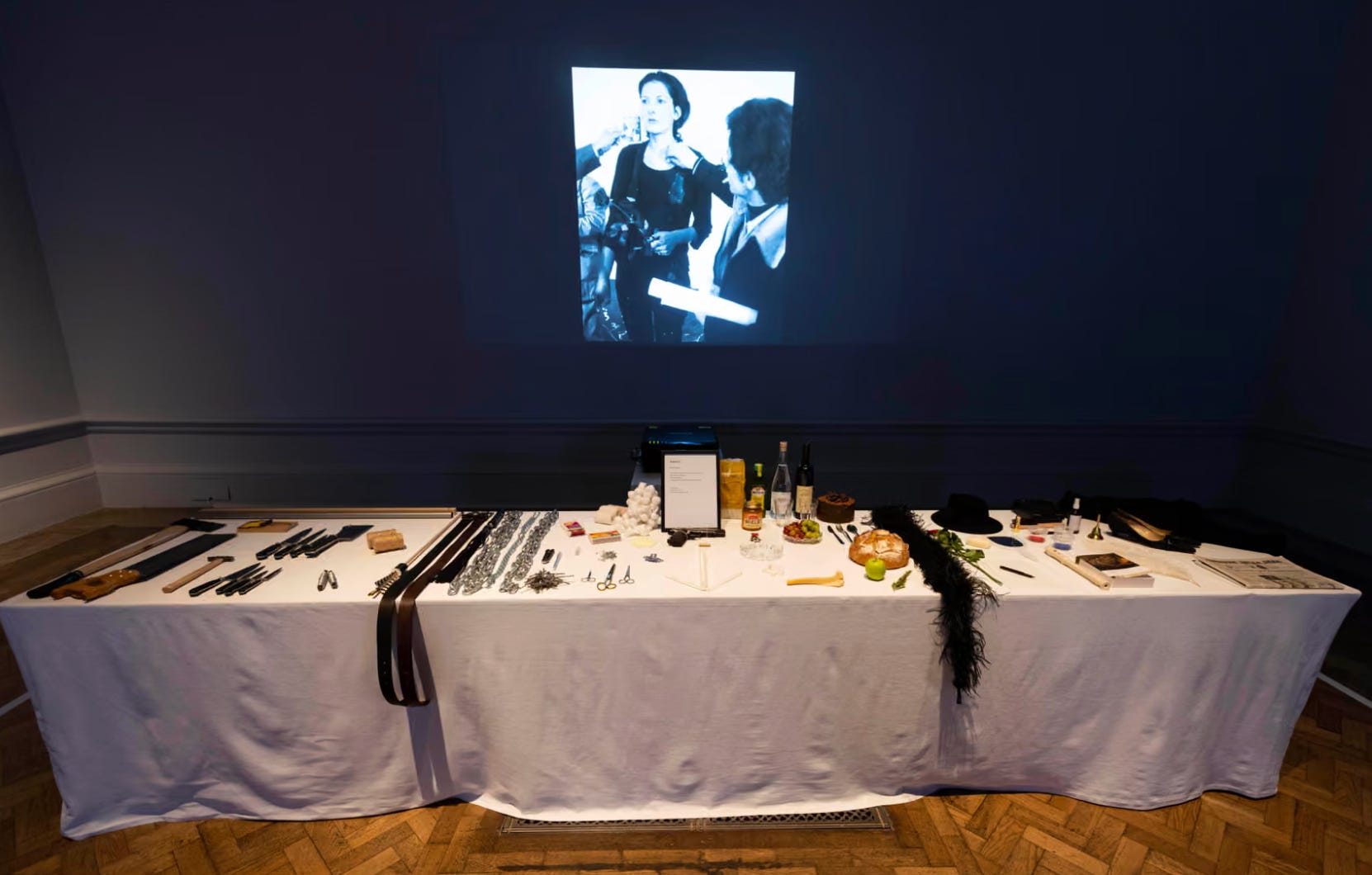
At first, the audience was hesitant, gentle and playful. They offered her flowers, or wrote and drew on her body. They turned her position.
But eventually things escalated. Once participants realized that there would truly be no consequences for what they’d do to her, they became more aggressive. They cut her clothes until she was half-naked, violated her bodily boundaries, sliced her skin until she bled, and pointed a loaded gun at her head.
The person holding the gun tried to manipulate her fingers towards the trigger to see if she’d resist. It was aimed at her.
It was at that point that some spectators intervened and took the gun away.
Once the six hours passed, Abramović began to walk toward the crowd. Unable to face her, those who had been willing to touch, cut, strip, and injure her had literally fled the gallery.
She was naked, bleeding, and crying.
No longer just an object but a human, they couldn’t face her.
It was a heartbreaking lesson about human nature. She said: “The experience I learned was that…if you leave decision to the public, you can be killed.”
When you remove consequences, there will be people who will do the worst.
“I really feel I was a mirror to the public, so however the public felt, it was projected on me.”
But there’s another lesson here—perhaps a more significant one. It is about what happens when others remain silent.
Most of the people who were there didn’t necessarily participate in the acts of cruelty. Most of them simply watched in silence.
It was only when the situation escalated significantly that some people ended up intervening. But it was limited.
After someone cut her neck, another spectator put on band-aid over the wound. When the gun was aimed at Abramović, several spectators physically confronted the person and took the gun away.
That intervention possibly saved her life.
But the silent played a role. As some became increasingly aggressive, their silence allowed them to continue. It was, in a way, perceived as permission. And a lack of social consequences.
Once people began to act, they were able to prevent further harm to her.
But the silence, one could argue, was part of the abuse. And why were they silent? Was it a desire to fit into the group? Conformity? Vicarious abuse and morbid curiosity? Fear of judgement? Not feeling responsible for the actions of others? A belief that someone else would intervene if things were really that bad? Support?
We don’t know.
But these are the same forces that can keep people silent when they witness all kinds of wrongdoing. We don't necessarily need to approve of something to allow it to continue as long as enough people stand there and do nothing.
To me, it is a more interesting question than why people hurt her in the first place. Some people will always have it in them to hurt other human beings when presented with the opportunity. That’s the unsettling reality of human nature. But whether they are able to do so and how far they can go depends enormously on the environments around them.
When people are silent. When they don’t intervene in the damaging actions of others. That’s when such wickedness is able to thrive. When everyone watches a disturbing thing happen, it gives it permission to continue. Silence isn’t neutral because of what it allows to happen.
But when someone steps in, it often encourages others to do the same as well. They see that someone else sees that something is wrong and is willing to do something about it.
Just as silence is contagious, so can courage be.
In my book, No Apologies: How to Find and Free Your Voice in the Age of Outrage, I deal with a lot of the same themes about the pressure to conform, our fear of social consequences, and the tendencies we have to see what everyone else is doing before deciding to speak up. It also deals with the tragic consequences of remaining silent in certain situation.
Often, the opinions we believe to be unpopular are shared by a lot more people than we think. And, sometimes, the truly unpopular opinions are the morally correct ones.
Want to support my work? Here’s how you can help:
Consider becoming a subscriber (and enjoy a week of premium for free!)
Share my posts and Substack with people who might enjoy it. Liking and commenting also helps more people discover my essays!
Make a one-off donation via Buy Me a Coffee
Pick up a copy of my book, No Apologies: How to Find and Free your Voice in the Age of Outrage
Walked through Dachau in 1969 as an 18 year old. It left me and my 4 friends speechless. On the bus back to the train station and the train back to Munich we looked at the Germans with the same thought. WTF?????? Wtf did we just see and WFT how did you remail silent while this went on. On a much simpler level I spotted a women in a grocery parking lot who had fallen and badly cut her leg. People were walking by. I didn't. Couldn't believe it, but I also could.
It's funny that the same rules don't apply online. There is less accountability and confrontation has the opposite effect.